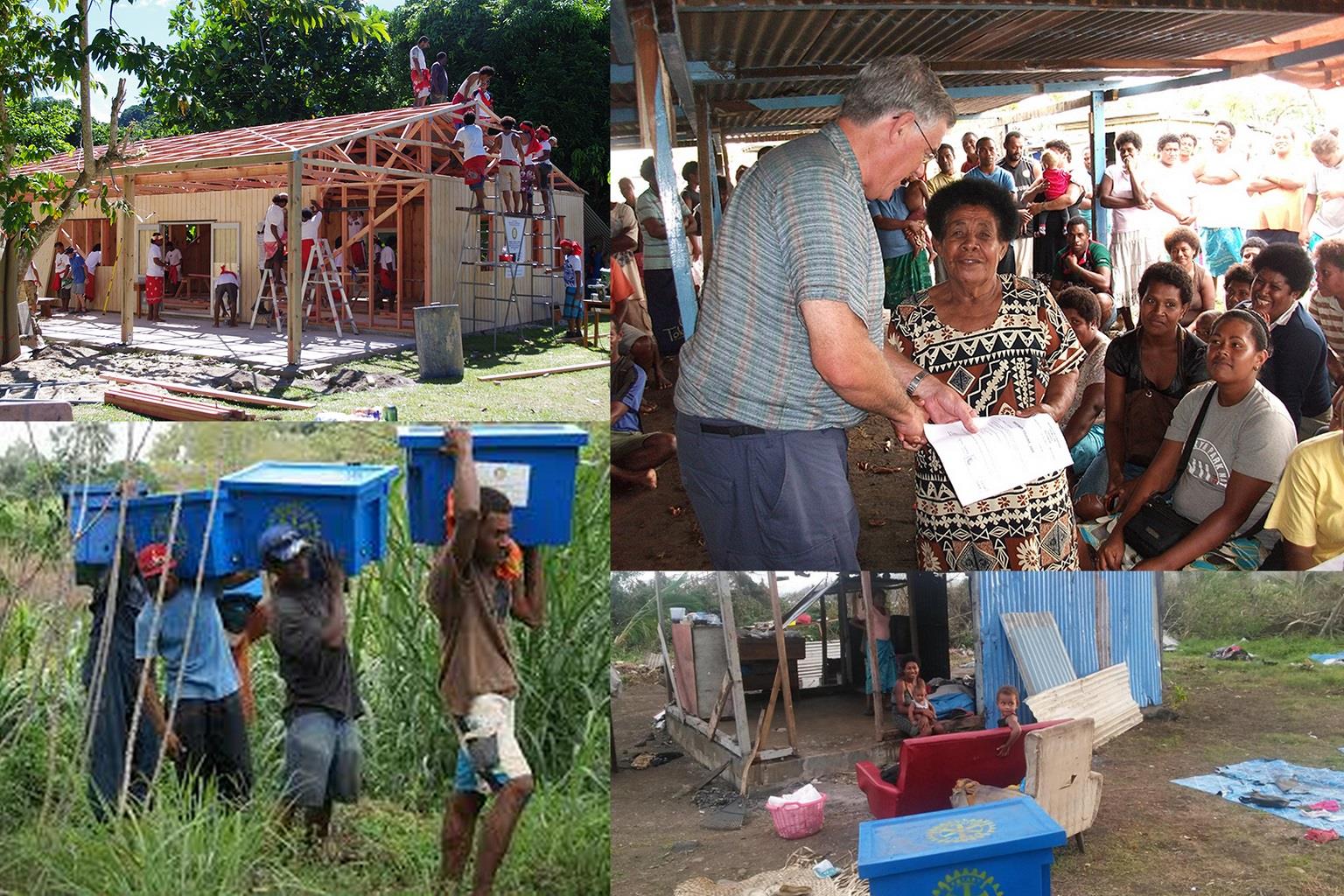
Stuart Batty gave us a sound overview of his recent experiences with Rotary NZ Community Service with respect to their primary aim being “to be there when disaster hits” and, in particular, the provision of emergency kits to affected communities.
These kits are distributed throughout the Pacific in response to tsunamis, floods and cyclones with over 10,000 kits having been distributed over the last decade. Auckland is currently packing 500 kits via a warehouse that has been made available for Rotary to use at this time.
This year weather related events are likely to be severe in the West with the Solomons, Vanuatu and PNG being some of the areas in the firing line.
Deliveries in the past have used wheelie bins transported initially by Hercules which were quite the challenge as they did not pack well into containers and don’t float. New square packaging is now being used which will increase the numbers per load and assist with onsite distribution by boats in particular. These deliveries also often include boxes of food which is well received.
Stuart shared that Rotary is also on the lookout for “old goods” with desks & chairs for schools and manual beds for hospitals. Over 4,000 desks have been distributed in recent times. Rotary also received over $200,000 worth of 2nd clothing last year.
Goods travel on two main ships and by truck to the warehouse. Time is of the essence as the ships need to get underway as quickly as possible.
Fiji is especially well organised at the receiving end with a local contact helping out extensively when goods arrive at their destinations.
Last year one of the major events was a flood that affected the outer islands. Desks were especially useful in ensuring schools were able to quickly get underway again.
Stuart shared the challenges faced by the severe damage cyclone Winston caused in Fiji. All damaged equipment was quickly buried in holes. Tents were then erected to restart many schools. One of the challenges is that tents are often still being used a year after an event as many places receive little additional support.
One particular school was totally rebuilt by Rotary with many of the desks coming from Christchurch. They were also supplied with a large number of books to replace what had been destroyed or damaged.
$250,00 was received after Winston to rebuild houses as homes for teachers who otherwise would have to travel to teach on one island while residing on another. The value of onsite accommodation makes it significantly easier for them to be able to teach away from their homes.
Stuart next shared a current hospital programme that is going to be completed as a Ronald McDonald facility catering for young pregnant women nearing their delivery times. Another programme that has been very successful teaches attendees how to grow vegetables and raise livestock.
Other ways the RNZCS assists include supporting disabled workers with housing & recreation and outfitting ambulances which helps with the moving of patients to other islands where required treatment is available. A new project that is underway is going to build small homes for displaced families. They have also built a village that can house up to 1,500 people following significant damage from a cyclone.
In terms of where support comes from, Stuart listed the following: Rotary Clubs, the Rotary Foundation, plus the NZ and Fiji Governments.
Two additional ways islanders are assisted are with water & sanitation requirements plus cataract surgery which has huge support from surgeons from many countries. This includes helping one young child who, until they received this surgery, had never seen his family before.
Finally, Stuart shared that education support is big with Rotary in especially Vanuatu and Fiji where they are building preschools. These are being constructed to a very high standard which can survive a Category 5 cyclone. They will then also be available as evacuation centres in future emergencies.
Thank-you, Stuart, for your informative update on this important work that Rotary supports.